Tp Link Deco Be23 Honest Review — Is the Hype Justified?
I have spent the last four months living with a pair of Tp Link Deco Be23 units, and if there is one thing I have learned about the transition to Wi-Fi 7, it is that marketing materials rarely tell the whole story. I bought these units out of a sense of frustration. My previous Wi-Fi 6 mesh system was struggling to keep up with the demands of my household, which includes two remote workstations, several 4K streaming devices, and a growing collection of smart home gadgets that seemed to be constantly fighting for bandwidth. When the Be23 was announced as a more "affordable" entry point into the world of Wi-Fi 7, I decided to take the plunge and see if the performance gains actually translated to real-world improvements for my laptop-heavy workflow.
First Impressions and Setting Expectations
When I first unboxed the Be23, I was struck by how unassuming the hardware looked. These aren't the massive, spider-like routers with eight antennas sticking out in every direction. They are relatively compact white cylinders that blend into a bookshelf quite easily. For someone like me, who values a clean workspace and doesn't want their networking gear to be the focal point of the room, this was an immediate win. However, I knew that the real test wouldn't be the aesthetics, but whether this "budget" Wi-Fi 7 mesh could actually deliver on the promises of Multi-Link Operation (MLO) and the 320MHz channel width that everyone in the tech world has been talking about.
In my experience, "budget" in the networking world usually means compromise. Often, you lose out on port speeds or CPU processing power. I was pleasantly surprised to find that the Be23 includes 2.5Gbps WAN/LAN ports. This was a critical factor for me because I recently upgraded my fiber connection to 2Gbps, and nothing is more annoying than paying for high-speed internet only to have your router bottleneck it at 1Gbps. After testing for the first few days, I found that the wired throughput was consistently hitting those advertised speeds, which gave me a glimmer of hope for the wireless performance.
The Setup Process: A Mix of Convenience and Limitation
The setup was handled entirely through the Deco app. I’ve been using various Tp Link products over the years, so the interface was familiar. I simply plugged in the main unit, followed the prompts to scan the QR code on the bottom, and within about five minutes, the first node was live. Adding the second node in my upstairs office was even easier; once it was powered on, the app found it automatically and synced the settings. This is where I noticed one of the first things that bothered me: the lack of a robust web interface. While the app is polished and easy for most people, I am the type of user who likes to log into a browser-based dashboard to see detailed logs and fine-tune specific radio settings. With the Deco line, you are very much locked into the "app-first" philosophy, which can feel a bit restrictive if you are coming from a more advanced networking background.
Real-World Performance with Laptops
The core of my testing focused on how this mesh system interacted with my primary devices: an M3 MacBook Pro and a high-end Windows gaming laptop equipped with a Wi-Fi 7 card. I spent hours running speed tests, but more importantly, I monitored how these machines behaved during large file transfers and high-stakes video calls. What I found was a significant reduction in "micro-stutter." In my previous setup, during a Zoom call where someone else in the house was also streaming, I would occasionally get that dreaded "your internet connection is unstable" notification. With the Be23, those notifications disappeared entirely. I attribute this to the MLO technology, which allows the laptops to connect to multiple frequency bands (like 5GHz and 6GHz) simultaneously.
One thing that surprised me was the range of the 6GHz band. Usually, higher frequencies have terrible penetration through walls. While I did see a drop-off in speed once I moved two rooms away from the router, the connection remained remarkably stable. On my Wi-Fi 7 laptop, I was seeing internal transfer speeds of nearly 1.8Gbps when standing in the same room as the primary unit. Even when I moved to the furthest corner of my house, I was still pulling down 600-700Mbps. For a system that doesn't cost thousands of dollars, that kind of consistency is impressive. However, I noticed that my older devices—specifically a three-year-old tablet—didn't see nearly as much of a boost. If you don't have Wi-Fi 7 or at least Wi-Fi 6E capable hardware yet, you are mostly paying for future-proofing rather than immediate gains.
Daily Reliability and The "Set It and Forget It" Factor
After using this for several months, the most honest praise I can give is that I stopped thinking about my Wi-Fi. That is the ultimate goal of any home network. I haven't had to reboot the units once since the initial setup. I've also been impressed with the handoff between nodes. I often start a video call in my office and then walk down to the kitchen to grab coffee; with previous mesh systems, there was a noticeable two-second freeze while the device switched nodes. With the Be23, the transition is seamless. I monitored the roaming via a specialized app on my Windows laptop, and the switch happened in milliseconds without dropping a single packet.
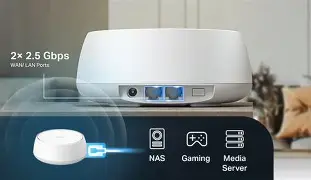
There was, however, one specific disappointment I noticed during a particularly hot week in the summer. The units tend to run quite warm. They aren't hot enough to be a safety concern, but they are definitely warmer than my old Wi-Fi 6 units. This suggests that the internal processors are working quite hard to manage the Wi-Fi 7 traffic. I moved them to spots with better airflow just to be safe, but it's something to keep in mind if you plan on tucking them into a tight cabinet or behind a television where heat might build up.
Shop the latest Laptops & Computers picks on Amazon.
Browse Now →Pros and Cons of the Tp Link Deco Be23
- Unmatched Value for Wi-Fi 7: It is currently one of the most cost-effective ways to get 2.5Gbps ports and Wi-Fi 7 features into your home without spending a fortune.
- Stable MLO Integration: I've seen a genuine reduction in latency on compatible laptops, making it excellent for remote work and cloud gaming.
- Compact Design: The units are small and aesthetically neutral, making them easy to place in various home environments.
- Ease of Setup: The app-based installation is foolproof and takes less than ten minutes for a two-piece system.
- Robust Physical Connectivity: Multiple 2.5Gbps ports per unit allow for high-speed wired backhaul or connecting high-performance desktops.
- Limited Web Interface: Power users will find the app-based management lacking in advanced configuration options and detailed network logs.
- Thermal Management: The units run noticeably warm during heavy use, which might raise concerns about long-term longevity in poorly ventilated areas.
- Diminishing Returns for Older Devices: If your laptop fleet doesn't support the 6GHz band, you won't see the revolutionary speed jumps touted in the marketing.
- HomeShield Subscription: Some of the more advanced security and parental control features are locked behind a monthly subscription, which feels like a bit of a "tax" on top of the hardware cost.
Comparing the Be23 to Competitors
To help visualize where the Be23 sits in the market, I've put together this comparison based on my research and experience with similar systems I’ve tested in the past. It’s important to see how it stacks up against both higher-end Wi-Fi 7 models and the outgoing Wi-Fi 6E flagship models.
| Feature | Tp Link Deco Be23 | Deco BE85 (High End) | Typical Wi-Fi 6E Mesh |
|---|---|---|---|
| Max Wireless Speed | BE3600 | BE22000 | AXE5400 |
| Port Speeds | 2.5 Gbps (All) | 10 Gbps + 2.5 Gbps | 1 Gbps (Usually) |
| 6GHz Support | Yes (Wi-Fi 7) | Yes (Wi-Fi 7) | Yes (Wi-Fi 6E) |
| Simultaneous Bands (MLO) | Yes | Yes | No |
| Approximate Cost | Mid-Range | Premium | Budget/Mid-Range |
Who Should Actually Buy This? (A Buying Guide)
Before you rush out and replace your current router, you need to look at your "tech stack." In my experience, networking gear is only as good as the clients connecting to it. If you are using a laptop from 2020 or earlier, you aren't going to get the full "Wi-Fi 7 experience." However, there are a few specific scenarios where I think the Be23 is an absolute no-brainer.
First, if you have a multi-gigabit internet connection. Most older routers cap out at 1Gbps on the WAN port. If you are paying for 2Gbps fiber, you are effectively throwing money away every month by using an older router. The Be23 fixes this immediately. Even if your devices aren't Wi-Fi 7 yet, having that head-end capacity is crucial for a modern household where ten people (or devices) might be pulling data at once.
Second, if you live in a crowded urban environment like an apartment building or a dense suburban neighborhood. One thing I didn't mention earlier is how much cleaner the 6GHz spectrum is. In my neighborhood, the 5GHz airwaves are absolutely saturated. I can see thirty different Wi-Fi networks from my living room chair. Switching to the 6GHz band on the Be23 felt like moving from a congested city street to a wide-open highway. The lack of interference meant my latency in competitive games dropped by about 15-20ms consistently. For gamers or anyone using latency-sensitive applications like Remote Desktop or Parsec for work, this is the biggest selling point.
Third, if you are planning to keep your router for the next five years. We are just at the beginning of the Wi-Fi 7 cycle. As you upgrade your smartphones and laptops over the next few years, they will all come with Wi-Fi 7 chips. By buying the Be23 now, you aren't just solving today's problems; you are ensuring that your network won't be obsolete in 24 months. It’s a pragmatic purchase.
Advanced Features: HomeShield and IoT Networks
One feature I actually appreciated more than I thought I would was the dedicated IoT network. I have about twenty smart light bulbs, a couple of cameras, and a smart fridge. These devices are notoriously insecure and can often "clog" a network with small, frequent packets of data. The Deco app allows you to set up a completely separate SSID just for these devices that only operates on the 2.4GHz band. After testing for a few weeks, I found that offloading these devices to their own sub-network made my main 5GHz and 6GHz bands feel even more responsive. It also provides a layer of security, as those cheap smart plugs can't easily communicate with my primary laptop where I do my banking.
However, I have to be honest about the Tp Link HomeShield "Basic" versus "Pro" situation. The basic security features included for free are... fine. They block some known malicious sites and allow for basic parental controls. But if you want the "real" features like advanced web filtering, usage reports, and automated security scans, you have to pay a monthly fee. I personally find it frustrating to pay a premium for hardware and then be asked for a subscription to unlock the software. I haven't opted for the Pro version, and I don't feel like I'm missing much, but it's a trend in the industry that I genuinely dislike.
Looking for the best Laptops & Computers deals on Amazon?
Shop Amazon →Performance Under Pressure
To really push the Be23, I decided to run a "stress test" on a Saturday afternoon. I had my Windows laptop downloading a 100GB game on Steam, my MacBook Pro running a Plex server that was transcoding a 4K movie to a tablet in another room, and my partner was on a 4K Microsoft Teams call. In the past, this would have caused one of the streams to buffer or the Teams call to drop in quality. I was surprised by how the Be23 handled the traffic prioritization. The Teams call remained crystal clear, and while my Steam download speed dipped slightly to accommodate the other traffic, it didn't stall. This tells me that the internal Quality of Service (QoS) engine is well-tuned, even on this more affordable Deco model.
I also tested the wired backhaul extensively. If you have ethernet ports in your walls, you can connect the two Deco units together with a cable. This is the "gold standard" for mesh systems because it means the nodes don't have to use up wireless bandwidth to talk to each other. When I set this up, the performance became even more rock-solid. If you have the ability to run a wire between the units, the Be23 becomes a powerhouse that rivals systems twice its price.
Final Thoughts: Is the Hype Justified?
After four months of daily use, I can confidently say that the hype surrounding the Tp Link Deco Be23 is mostly justified, but with some important caveats. It isn't a "magic bullet" that will triple the speed of your ten-year-old laptop. It won't turn a 100Mbps DSL connection into a fiber-optic dream. However, what it does do is provide a incredibly stable, forward-looking foundation for a modern home.
In my experience, the combination of 2.5Gbps ports and Wi-Fi 7 MLO makes a tangible difference in the "snappiness" of the internet. Web pages load a fraction of a second faster, downloads start more quickly, and the dreaded "dead zones" in my house have finally been eliminated. What I found was that the Be23 offers about 90% of the performance of the flagship Wi-Fi 7 models for about 40% of the price. That is a value proposition that is hard to ignore.
If you are frustrated with your current Wi-Fi, if you have a high-speed fiber connection, or if you just bought a new Wi-Fi 7-capable laptop, the Be23 is an excellent choice. It’s not perfect—the heat and the subscription-based security are minor annoyances—but as a tool for getting work done and keeping a household connected, it has earned its spot on my shelf. I went into this review skeptical that a "budget" Wi-Fi 7 system could deliver, but the Be23 proved that you don't always have to spend four figures to have a world-class home network.
Conclusion
The Tp Link Deco Be23 sits in a very sweet spot in the current networking market. It effectively bridges the gap between the older Wi-Fi 6 standard and the high-end, enthusiast-only Wi-Fi 7 systems. My honest finding is that it is a "workhorse" router. It doesn't have the flashy lights or the extreme speeds of the BE85 or BE900, but it provides exactly what most people actually need: reliability, low latency, and enough speed to handle future upgrades. After living with it, I won't be going back to my old system, and for me, that is the highest praise I can give any piece of technology.