Don't Buy the Color Imageclass Mf656Cdw Mf654Cdw Until You Read This Full Analysis
In the evolving landscape of the modern home office and small business environment, the demand for high-quality color laser printing has never been higher. As remote work becomes a permanent fixture for many and small enterprises seek to bring professional-grade marketing production in-house, the Canon Color Imageclass MF656Cdw and MF654Cdw have emerged as leading contenders in the mid-range multifunctional printer market. However, investing in a laser printer is not a decision that should be made solely based on a brand name or a sleek exterior. It requires a deep dive into the technical specifications, the long-term cost of ownership, and the specific ergonomic realities of daily use.
The MF650 series, which includes both the MF656Cdw and the MF654Cdw, is designed to bridge the gap between compact consumer-grade printers and large, enterprise-level floor models. They promise speed, vivid color output, and a suite of scanning and copying features that aim to streamline office workflows. Yet, there are significant nuances between these two models and several industry-specific trade-offs that potential buyers frequently overlook. This analysis serves as a comprehensive guide to understanding whether these machines truly deserve a spot on your desk or if they represent a legacy approach to printing that might not align with your specific modern needs.
Detailed Product Analysis: The Core of the MF650 Series
To understand the MF656Cdw and MF654Cdw, one must first understand what they share. Both machines are built upon a color laser engine capable of delivering 22 pages per minute in both black and white and color. This is a respectable speed for a small office, though it falls short of high-volume workgroup machines. The technology at play here is Canon's V2 (Vivid and Vibrant) Color technology, which is specifically tuned to expand the color gamut in darker areas and highlights, resulting in prints that often look more like professional lithography than standard office xerography.
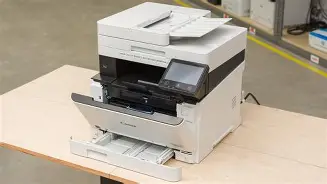
The hardware is dominated by a 5-inch color touchscreen that mimics the interface of a smartphone. This is a critical design choice by Canon, moving away from the button-heavy layouts of the past. The interface allows for the creation of "Application Libraries," where users can program one-touch buttons for complex tasks, such as scanning a document, converting it to a searchable PDF, and emailing it to a specific department simultaneously. This level of customization is what separates these models from basic, entry-level laser printers.
The Connectivity Suite
Modern printing is as much about software as it is about toner. Both models support a wide array of connection methods. Wi-Fi Direct capability is standard, allowing guests or mobile users to print without needing access to the primary secure office network. They are fully compatible with Apple AirPrint and Mopria Print Service for Android, which are essential features for offices that rely on tablets and smartphones. Furthermore, the inclusion of the Canon PRINT Business app provides a more granular level of control, allowing users to track toner levels and manage scanning settings directly from a mobile device.
Engine and Paper Handling
The physical footprint of these printers is substantial. They are "cube-style" machines that require a dedicated stand or a very sturdy desk. The paper handling consists of a 250-sheet main cassette and a 1-sheet manual bypass slot. For many, the 250-sheet capacity is a "Goldilocks" zone—it holds exactly half a ream of paper, reducing the frequency of refills without making the machine prohibitively large. However, for those who regularly print long reports or manuals, the lack of an optional second paper tray might be a limiting factor.
The Critical Differences: MF656Cdw vs. MF654Cdw
Many consumers find themselves confused by the price gap between these two models, as they look nearly identical. The distinction lies almost entirely in the "extra" features designed for the most demanding office environments. The MF656Cdw is the flagship of this specific sub-series. It includes two key features that the MF654Cdw lacks: Single-Pass Duplex Scanning and Fax capability.
Single-pass duplex scanning is a game-changer for businesses that digitize large volumes of double-sided documents. While the MF654Cdw can scan both sides of a page, it typically requires a "reversing" document feeder which pulls the page in, scans one side, flips it mechanically, and scans the other. This adds time and increases the risk of paper jams. The MF656Cdw uses two separate scanning sensors to capture both sides of a page in a single movement. This not only doubles the scanning speed but also treats delicate documents with more care. Additionally, while the world has largely moved to email, certain industries like law, healthcare, and real estate still require traditional faxing. The MF656Cdw satisfies this requirement, whereas the MF654Cdw is strictly a print/scan/copy device.
Discover deals on Electronics — updated daily.
Browse Now →Pros and Cons: A Balanced Perspective
Evaluating these machines requires looking beyond the spec sheet to the actual user experience. Buyers often care most about reliability, print quality, and ease of setup.
- Pro: Exceptional Print Quality – The laser technology ensures that text is crisp and smudge-proof, making it ideal for client-facing documents. The color accuracy is superior to many competitors in the same price bracket.
- Pro: User Interface – The 5-inch touchscreen is responsive and highly intuitive, significantly reducing the learning curve for new employees.
- Pro: Security Features – Canon includes "Verify System at Startup," a process that checks the firmware for unauthorized modifications, which is a vital safeguard against modern cyber threats targeting office hardware.
- Pro: Quiet Operation – Compared to older laser models, the MF650 series operates with a relatively low acoustic footprint, making it suitable for small rooms or open-concept offices.
- Con: High Cost of Consumables – Like many color laser printers, the cost of genuine toner can be high. Four separate cartridges (Cyan, Magenta, Yellow, and Black) mean that a full replacement can sometimes approach the cost of the printer itself.
- Con: Heavy Weight – Weighing in at over 40 pounds, these are not portable devices. Setting them up usually requires two people to avoid strain.
- Con: Starter Toner Capacity – The "starter" cartridges included in the box have a significantly lower yield than standard replacement cartridges, meaning heavy users will be looking for replacements sooner than expected.
Comparative Analysis of the Series
To better visualize where your money goes when choosing between these models, the following table breaks down the technical specifications and feature sets that define the MF656Cdw and the MF654Cdw.
| Feature | Color Imageclass MF656Cdw | Color Imageclass MF654Cdw |
|---|---|---|
| Print Speed (Letter) | Up to 22 ppm (Color/BW) | Up to 22 ppm (Color/BW) |
| First Print Out Time | Approx. 10.3 Seconds | Approx. 10.3 Seconds |
| Scan Type | Single-Pass Duplex ADF | Simplex ADF (Manual Duplex) |
| Fax Capability | Yes | No |
| Touchscreen Size | 5-Inch Color | 5-Inch Color |
| Standard Paper Capacity | 250 Sheets | 250 Sheets |
| Duty Cycle | Up to 30,000 Pages Monthly | Up to 30,000 Pages Monthly |
| Recommended Volume | 150 - 2,500 Pages Monthly | 150 - 2,500 Pages Monthly |
Buying Guide: Is This Series Right for Your Real-World Needs?
Choosing a printer is often about matching the machine’s "Duty Cycle" and "Recommended Monthly Page Volume" with your actual habits. The MF650 series is rated for a 30,000-page peak duty cycle, but its recommended volume is much lower, topping out at 2,500 pages per month. If you are a solo practitioner or a small team of 3-5 people, this is a perfect fit. If you are a high-volume real estate office printing 500-page contracts every day, you might find yourself replacing toner too frequently and stressing the mechanical components of the paper feeder.
The Question of Color vs. Monochrome
Before buying either the MF656Cdw or MF654Cdw, buyers must ask themselves if they truly need color. Many people buy a color laser printer "just in case" they need to print a photo or a colored logo. However, the internal complexity of a color laser printer means there are more parts that can fail compared to a monochrome unit. If 99% of your printing is text-based invoices or shipping labels, a monochrome Imageclass model will provide lower costs per page and faster speeds.
The Realities of Office Space
One common complaint from buyers is the size of these units. Because laser technology requires a fuser unit (which uses heat to bond toner to paper) and four separate toner drums, the internal chassis is bulky. You need to ensure you have at least 18 inches of clearance above the printer to open the document feeder and at least 24 inches in front to pull out the paper tray and access the toner drawer. In a cramped home office, this can feel overwhelming.
Analyzing Data Security
For those in the financial or medical sectors, the security features of the MF656Cdw are a significant selling point. Beyond the system verification at startup, these models support "Secure Print." This allows a user to send a confidential document to the printer, but the machine will not actually print it until the user physically walks to the device and enters a PIN code. This prevents sensitive information from sitting in an open tray where other employees might see it.
Cost of Ownership Analysis
The upfront price of these printers is often deceptive. To truly understand the value, one must calculate the cost per page (CPP). Generally, color laser printers in this class have a black-and-white CPP of around 2 to 3 cents and a color CPP of 12 to 15 cents when using standard-yield genuine cartridges. High-yield cartridges can bring these numbers down slightly. Potential buyers should look at their last few months of printing: if you print 1,000 color pages a month, you could be spending more on toner in a single year than you did on the printer itself. For such users, an ink-tank printer might be a more economical, if slower, alternative.
However, the value of a laser printer isn't just in the cost per page; it's in the reliability. Inkjet printers suffer from clogged nozzles if left unused for two weeks. Laser toner is a dry powder that does not "dry out." If you go on a month-long vacation, you can return and print a perfect page immediately. This reliability is why the MF654Cdw and MF656Cdw remain favorites for those who print intermittently but require professional results every time.
Find top-rated Electronics products at great prices.
Shop Amazon →Technical Installation and Maintenance
The setup process for the MF650 series has been streamlined compared to earlier generations. Canon provides a "Setup Guide" directly on the touchscreen that walks the user through connecting to the network and installing the toner. Unlike some competitors that require a forced cloud account or an active internet connection to function (the controversial "Printer as a Service" model), Canon allows these machines to operate as traditional local devices. This is a massive "pro" for privacy-conscious users or those with spotty internet connections.
Maintenance is also simplified by the "All-in-One" cartridge design. In many older or larger laser printers, the toner, the drum, and the waste-toner container are separate parts that must be replaced at different intervals. In the MF650 series, the drum and the toner are integrated into a single cartridge. When you replace the toner, you are essentially refreshing the most critical parts of the imaging system. This results in consistent print quality over the life of the machine, though it does contribute to the higher cost of the cartridges.
Final Environmental and Efficiency Considerations
Energy efficiency is another factor buyers are increasingly prioritizing. The MF650 series is Energy Star certified and features a "Sleep Mode" that consumes very little power when the machine is idle. The fuser technology is designed for "quick warm-up," meaning the machine can jump from deep sleep to printing the first page in about ten seconds. This avoids the long, energy-intensive "warming up" cycles that used to be a staple of laser office equipment.
Furthermore, the automatic duplexing (printing on both sides) is enabled by default. In a world where paper waste is a significant environmental and financial concern, this feature can easily cut a business’s paper consumption in half without requiring any extra effort from the employees. The MF656Cdw’s single-pass scanning also contributes to efficiency by reducing the mechanical wear and tear on the document feeder, potentially extending the physical life of the machine compared to models that use a reversing scanning mechanism.
Conclusion
The Canon Color Imageclass MF656Cdw and MF654Cdw are robust, high-performance machines that represent the current peak of mid-range color laser technology. They offer a rare combination of professional-grade print quality, an exceptionally user-friendly interface, and the kind of reliability that only laser technology can provide. For the small business owner or the home professional who needs to produce brochures, presentations, and crisp correspondence, these printers are difficult to beat.
However, they are not universal solutions. The high cost of replacement toner and the considerable physical size of the units are hurdles that must be acknowledged. If you do not require color, or if your scanning needs are minimal, you may find better value elsewhere in Canon’s lineup. But for those who decide that the MF650 series is the right fit, the choice between the two models becomes simple: if you need to scan double-sided documents quickly and still rely on a fax line, the MF656Cdw is the clear winner. For everyone else, the MF654Cdw provides the same stellar print quality and modern interface at a more accessible price point. In either case, these machines are a testament to how far office technology has come, providing a powerful set of tools that were once reserved for the largest corporations, now packaged for the desktop of a small business.